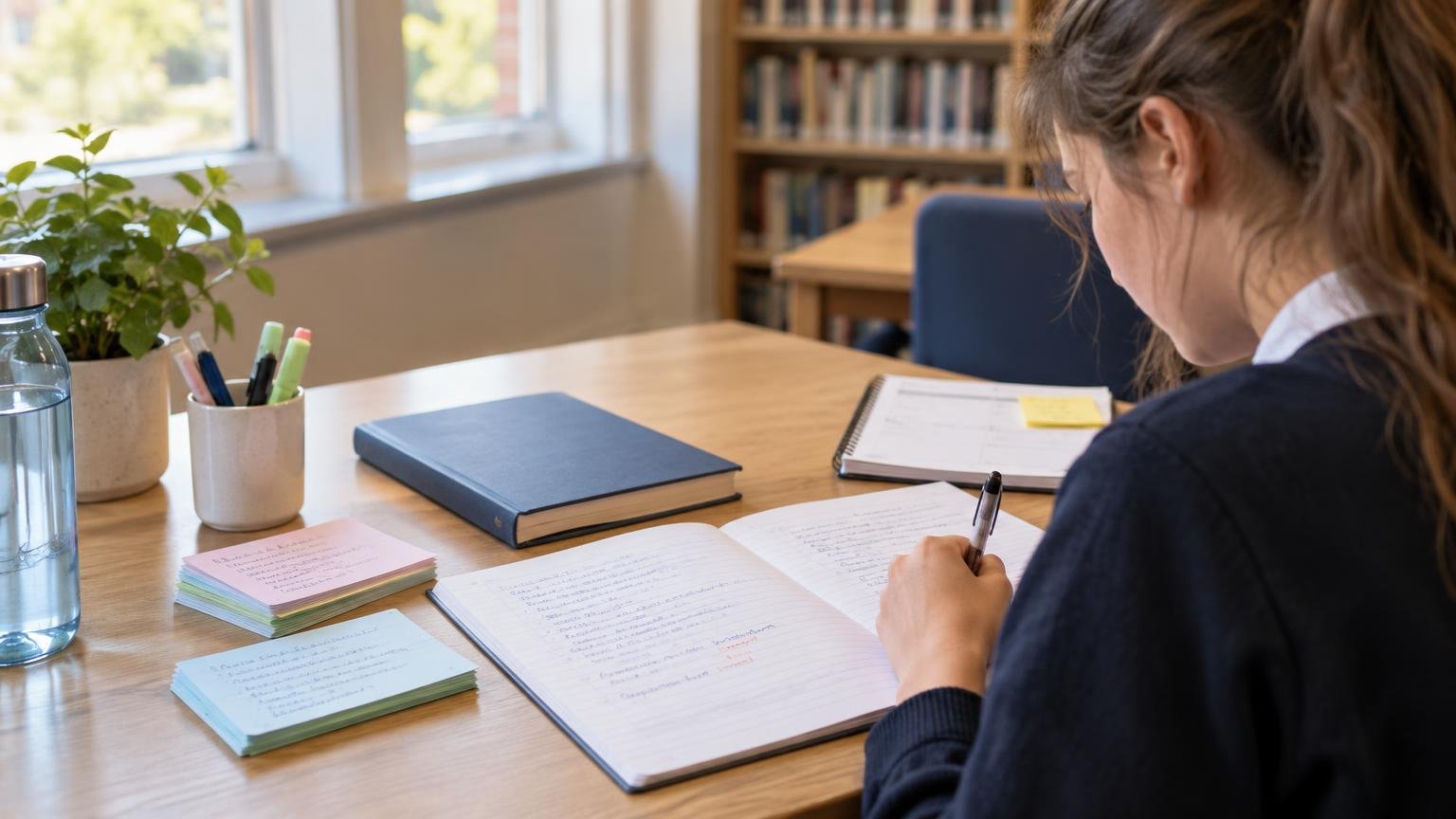
Active Recall for Secondary School Students: How to Use It Properly
TLDR: Active recall means putting your notes away, producing an answer from memory and then checking it carefully. The correct routine is: learn a manageable section, retrieve it without help, correct the exact gaps and return to those gaps later. It is not simply rereading notes or copying information onto flashcards.
The key to active recall for secondary school students how to use it properly is honesty. If the textbook is open, the answer is visible or someone gives you the first few words, you are recognising information rather than fully retrieving it. A short, genuine attempt followed by accurate correction is more useful than a long quiz completed with clues.
Research describes retrieval practice as recalling previously learned information and links it with later learning and retention. A systematic review covering 50 experiments in schools and classrooms found benefits across different subjects and settings, while also noting limitations in the available evidence. In other words, active recall is a well-supported technique, but not a magic replacement for lessons, understanding, writing practice or feedback. Read the Annual Review of Psychology overview of retrieval practice.
What active recall is—and what it is not
Active recall is any task that makes you generate previously learned information without looking at the source. You might write a definition, explain a process aloud, draw and label a diagram, complete a calculation, list evidence or plan an essay paragraph.
Flashcards can support active recall, but only if you attempt the answer before turning the card over. Making attractive cards is preparation; retrieving their answers is revision. The same distinction applies to other familiar activities.
| Activity | Active recall? | How to improve it |
|---|---|---|
| Rereading a chapter | No | Close the book and write the main ideas from memory. |
| Highlighting notes | Not by itself | Turn each highlighted point into a closed-book question. |
| Copying a worked example | No | Hide it and solve a similar problem independently. |
| Answering a flashcard before turning it over | Yes | Say or write the complete answer, then check it. |
| Completing an unseen question without notes | Yes | Mark it, identify the gap and retry it later. |
Use the learn, recall, check and revisit routine
1. Learn one manageable section
Active recall works with material you have already encountered. Start by making sense of a small taught section, such as the stages of mitosis, one method for solving simultaneous equations or the causes of a historical event. Ask for help if you do not understand it yet. Repeatedly testing a topic you were never taught clearly can rehearse confusion rather than resolve it.
2. Hide the source and retrieve
Close the book, cover the answer and remove digital notes from view. Choose a response that suits the subject: write, speak, sketch, label, calculate or create a quick plan. Make a real attempt before accepting a clue. It is fine to discover that you know less than expected; finding that gap is the point of the exercise.
3. Check and correct precisely
Compare your answer with reliable class materials, a textbook, the relevant specification or a teacher-approved mark scheme. Do not record only a tick or cross. Identify what was missing: a keyword, stage, quotation, calculation step, unit, example or piece of reasoning. Research on retrieval practice identifies corrective feedback as an important practical consideration, so checking should follow the retrieval attempt rather than replace it.
4. Revisit the gap later
Keep a short “not yet secure” list and test those items again after a break. There is no single timetable that suits every learner and topic. Revisit a weak answer soon enough that you can improve it, then leave longer gaps as it becomes more reliable. Secure material needs less attention than knowledge you repeatedly miss.
Make recall questions match the subject
A common mistake is using short factual flashcards for everything. Facts matter, but GCSE subjects also ask students to explain, calculate, compare, analyse and judge. Your recall prompts should require the same kind of thinking you will eventually need to produce.
| Subject | Weak prompt | Stronger retrieval task |
|---|---|---|
| Science | What is photosynthesis? | Write the word equation, explain what happens and identify two limiting factors. |
| Maths | Read the formula again. | Write the formula from memory, then use it in a problem and check every step. |
| English Literature | Who wrote the text? | Recall two relevant quotations and plan how each supports an interpretation of a theme. |
| History | When did the event happen? | Recall the date, then explain two causes and judge which was more significant. |
| Geography | List erosion processes. | Draw a labelled sequence showing how one process changes a landscape. |
| Modern languages | Recognise ten words. | Translate sentences from English, then say new sentences aloud without the list. |
| Religious studies | Name a belief. | Explain the belief, support it with a teaching and compare a contrasting view. |
For English, active recall can help you remember quotations, vocabulary and possible arguments, but it cannot replace complete essay practice. Once you can retrieve the material, use it to build analytical paragraphs and extended responses. Our guide to improving secondary-school English essays explains how to turn evidence into developed analysis.
Turn active recall into exam-facing practice
Start with simple prompts while learning, then make them more like assessment questions. Instead of asking “What were the causes?”, ask “Explain two causes” or “Which cause was most important, and why?” This forces you to retrieve information and organise it into the required form.
Check the wording used by your own teacher and exam board. AQA, for example, publishes subject-specific guidance explaining command words such as analyse, assess, compare, explain and summarise. Those definitions are useful for AQA students but should not automatically be applied to every qualification or board. See AQA’s English Language command-word guidance.
GCSE requirements and assessment details can vary by subject and exam board. Ofqual publishes qualification requirements and guidance for GCSEs graded 9 to 1 in England, but your relevant specification, teacher materials and official exam-board resources should guide the exact content you revise. Arrangements elsewhere in the UK can differ.
Move from topic recall to individual exam questions before attempting complete papers. When you are ready for longer assessment practice, use an attempt-mark-repair-retry loop rather than treating every paper as a one-off score. The guide to using past papers without wasting them sets out that process.
What to do when an answer is wrong
A wrong answer is useful only if you act on it. Avoid copying the entire model answer and moving on. Diagnose the smallest meaningful problem and choose the corresponding repair.
- Missing fact or keyword: add it to a short recall prompt and retry it later.
- Incomplete explanation: identify the missing link between cause and result, then say or write the full chain.
- Wrong calculation: find the first incorrect step and complete a similar question without looking.
- Weak evidence: retrieve one precise example, quotation or case detail that supports the point.
- Misread command word: rewrite the prompt in your own words and identify what the response must do.
- No understanding: stop self-testing and ask a teacher for an explanation, example or worked solution.
This process also helps you monitor your learning instead of judging revision by time spent. The Education Endowment Foundation frames metacognitive learning around planning, monitoring and evaluating. Active recall fits that wider cycle: decide what to practise, observe what you can produce and use the result to choose your next task.
Adapt the method without removing the retrieval
Active recall does not have to mean filling pages with handwriting. If writing speed, organisation or working memory makes that difficult, answer aloud, record a voice note, label a partly completed diagram or use a scaffold with headings. Text-to-speech can read a prompt, while speech-to-text can capture an answer. The important condition is that the source remains hidden while you generate the response.
Scaffolds should gradually reduce. You might begin with three headings, then one keyword and finally a blank page. If an agreed access arrangement is part of normal schoolwork or assessment, practise using it as your school advises rather than building a revision routine around support that will not be available.
How parents can help without taking over
A parent can read questions, keep answers covered and ask the student to explain how confident they are. The helpful response to a mistake is “What part was missing?” rather than immediately supplying the answer. Let the student finish, check against the agreed source and choose what needs another attempt.
Keep sessions short enough to remain focused, and avoid turning every result into a judgement about effort or ability. Active recall is supposed to reveal uncertainty. If a student feels they must get everything right, they may start peeking at answers—and the method loses much of its value.
Your five-minute active recall start
Choose one small topic you studied recently. Spend one minute writing a clear question, two minutes answering it with every source hidden and one minute checking the result. Use the final minute to record only the missing fact, method or explanation and decide when you will retry it.
The takeaway is simple: do not measure revision by how familiar the page looks. Learn something, close the source, produce the answer, check it honestly and revisit the precise gap. That repeatable loop is how secondary-school students turn active recall from a study buzzword into a practical revision habit.
References
- Practicing Retrieval Facilitates Learning | Annual Reviews
- ERIC – EJ1319572 – Retrieval Practice Consistently Benefits Student Learning: A Systematic Review of Applied Research in Schools and Classrooms, Educational Psychology Review, 2021-Dec
- The critical role of retrieval practice in long-term retention: Trends in Cognitive Sciences
- AQA | Command words
- GCSEs (9 to 1): requirements and guidance – GOV.UK
- Metacognition and Self-Regulated Learning | EEF