
Helping a Child Move From Primary to Secondary School
TLDR: Helping a child move from primary to secondary school is mainly about making unfamiliar parts of Year 7 feel manageable. Talk about specific worries, practise the journey and everyday routines, build independence gradually, and share important information with the new school. The goal is not to remove every nervous feeling; it is to give your child a plan for what to do when something feels difficult.
A child can be excited about new subjects and worried about getting lost at the same time. When helping a child move from primary to secondary school, avoid treating confidence as something they must achieve before September. Confidence usually grows through small experiences: reading a timetable, finding the right bus stop, asking an adult for help or discovering that one awkward day does not define the whole term.
Start with four useful questions
Broad questions such as “Are you worried?” often produce a shrug. A more specific conversation gives you something practical to work on. Try asking these questions during a walk, car journey or another low-pressure moment:
- What are you most looking forward to?
- What feels confusing or uncertain?
- What would make the first morning easier?
- Which adult could you approach if you were lost, upset or unsure?
Listen before offering solutions. A parent may be thinking about homework and punctuality while the child is concerned about where to eat lunch. Deal with the child’s actual concern first. If they do not want a long conversation, ask them to name one thing that feels exciting and one thing they want to find out.
The Children’s Commissioner for England offers transition resources for families that encourage children to think about questions for their new school, trusted support, activities and future goals. These prompts can make the discussion feel less like an interrogation and more like planning.
Make the new school feel more familiar
Secondary school brings several changes at once: a larger site, more pupils, different teachers, movement between rooms and a timetable that may change each day. You do not need to rehearse every possible situation. Focus on the places, people and procedures your child is most likely to need first.
Attend transition events where possible and use any map, photographs, virtual tour or welcome material supplied by the school. Department for Education guidance recommends looking at images of a new setting together and discussing what will be familiar and what will be different. If information has not been provided, ask the school where Year 7 pupils arrive, where they go if they are late and who supports pupils during the first few weeks.
Practise the journey at approximately the right time of day. Include the walk to the stop, road crossings and the final route onto the site. If your child will travel independently, agree what they should do after a missed bus, cancelled train or dead phone battery. Put essential contact details somewhere available without relying solely on a phone.
It also helps to rehearse a few ordinary sentences: “Could you show me where this room is?”, “I cannot find my class” and “Who should I speak to about my timetable?” Knowing the words can make asking for help easier under pressure.
Build independence without withdrawing support
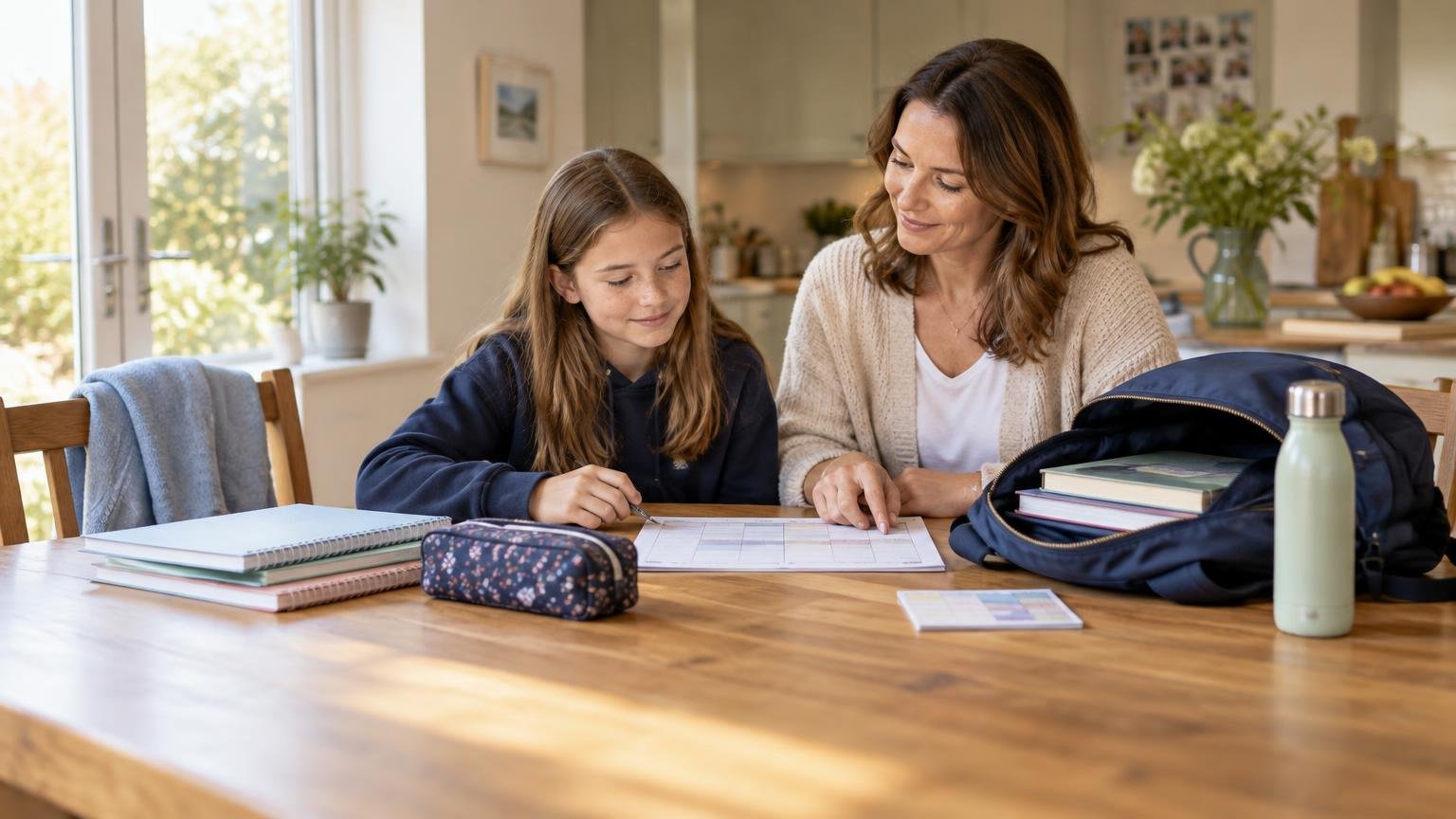
Secondary-school independence does not mean managing everything alone from day one. It means taking increasing responsibility with a reliable safety net. I would practise one routine at a time rather than handing over an entire list in the final week of the holidays.
| Skill | How to practise | Parent’s role |
|---|---|---|
| Packing a bag | Use tomorrow’s timetable to identify books and equipment | Check together at first, then step back gradually |
| Reading a timetable | Choose a day and trace each lesson, room and teacher | Explain unfamiliar abbreviations |
| Remembering equipment | Keep keys, travel pass and stationery in predictable places | Help create one short checklist |
| Managing homework | Record each task and its deadline in one agreed system | Review the system weekly rather than checking constantly |
| Solving small problems | Rehearse who to ask when lost or missing an item | Stay available without immediately fixing everything |
Use the school’s permitted system for reminders, whether that is a planner, app or paper checklist. Keep it simple. Three dependable habits are more useful than an elaborate colour-coded system that nobody wants to maintain after Tuesday.
Prepare for friendships without making promises
Friendship worries are common because children may be separated from familiar classmates or fear that groups will form immediately. Reassure your child that they do not need to find a best friend during the first week. A more realistic aim is to learn a few names, sit near someone approachable and try one activity connected to an existing interest.
Practise small ways to join in: asking what lesson someone has next, checking whether a seat is free or asking about a club. If possible, keep one familiar out-of-school activity during the transition. It can provide continuity when much of the school day feels new.
Take concerns about bullying seriously, but do not predict that it will happen. Ask the school how pupils report problems, which adults supervise social times and how parents should raise a concern. If an incident occurs, record what happened, when, where and who was involved, then contact the appropriate member of staff rather than asking the child to manage repeated behaviour alone.
Create a first-term routine that leaves room to recover
The first weeks can be tiring even when they are going well. A child is learning routes, names, rules and social expectations throughout the day. Build a predictable evening and morning pattern before term starts: check the next day’s timetable, pack the bag, prepare clothing and set an agreed bedtime and leaving time.
Allow some decompression after school before asking for a full report. A snack and quiet break may lead to a better conversation than questions at the front door. Later, try “What was easier than you expected?” or “Was there anything you want help planning for tomorrow?”
Attendance routines matter particularly during the move between primary and secondary school, and Department for Education guidance emphasises early communication between families and schools when difficulties emerge. If anxiety begins to cause repeated lateness, absence, sleep problems or distress, contact the school early. Ask for a named person and a practical plan rather than waiting for the problem to become established. Persistent or severe distress may also require advice from an appropriate health professional.
Tell the school what helps your child
Do not assume every useful detail will transfer automatically from the primary school. Ask how transition information is shared and provide a concise summary where appropriate. Include strengths as well as needs, because interests and successful strategies can help staff build trust.
- Interests, strengths and activities that help your child connect with others
- Communication needs or situations in which instructions become difficult to process
- Known worries, triggers and signs that your child is becoming overwhelmed
- Strategies that help your child calm down, refocus or ask for a break
- Medical needs, allergies, medication arrangements and relevant care plans
- Existing adjustments, accessibility needs or support that has worked at primary school
- The best contact route if the school needs to discuss an emerging problem
Ask who will receive this information and who your child can approach. Depending on the school, that might be a form tutor, head of year, pastoral lead, SEND coordinator or another named member of staff. School structures vary, so use the titles and contact routes supplied by the new school.
Extra transition planning for SEND or disability
A child with special educational needs or a disability may need a more personalised transition rather than simply more reassurance. Useful measures can include additional visits at quieter times, photographs or a visual route, advance notice of key adults, a transition meeting, accessible travel planning and a clear arrangement for breaks or support.
Ask the primary and secondary school what information will be transferred, who is coordinating the process and how agreed support will work in practice. If your child uses communication aids, sensory equipment or a particular calming strategy, discuss where these will be available and whether staff need additional information.
In England, where a child with an education, health and care plan is transferring from primary to secondary school, the review and amendment process must be completed by 15 February in the calendar year of transfer. Families should raise questions about the named placement, provision or transition plan with the relevant local authority and school well before that deadline. Arrangements and terminology differ elsewhere in the UK.
Admissions and transition are separate tasks
Applying for a school place and helping a child settle are related, but they are not the same process. Admissions determine where a place is offered. Transition planning prepares the child for attending that school once the placement is known.
In England, parents normally apply through their local council and list their preferred schools in order. Local arrangements can include additional requirements, so use the official GOV.UK school admissions guidance to find the relevant council and check its current timetable, supplementary forms, late-application process, waiting lists and appeals information. In Wales, admissions are also managed through the relevant local authority, but England’s dates and procedures should not be assumed to apply. Scotland and Northern Ireland have their own systems, so families should consult the appropriate council or education authority.
Questions to ask at a transition event
A transition day or parent information evening can provide a great deal of information at once. Take a short list and prioritise answers that change what your family needs to do.
- Where should Year 7 pupils go when they arrive?
- How do pupils ask for help if they are lost or late?
- Who is the main pastoral contact for pupils and parents?
- How are timetables, homework and messages provided?
- What equipment is genuinely needed on the first day?
- How are medical needs, SEND support and existing adjustments managed?
- What is the procedure for reporting bullying or friendship problems?
- Which clubs or supervised activities are available to new pupils?
Your child may also benefit from reading what to expect in the first week of secondary school, which covers common questions about lessons, lunch, timetables and solving everyday problems.
What to do this week
Choose just three actions: one practical task, one social question and one support contact. For example, practise the journey, ask your child what would make lunchtime easier, and identify the member of staff to contact if worries begin affecting attendance.
That is a strong starting point. Helping a child move from primary to secondary school is not about planning every minute of Year 7. It is about making the next step clear, showing that help is available and letting your child take manageable amounts of responsibility. Review the plan after the first week, keep what works and adjust one difficulty at a time.
References
- Resources for families | Children's Commissioner for England
- The back-to-school reset guide (accessible version) – GOV.UK
- A guide for schools on communicating with parents about attendance (accessible version) – GOV.UK
- Schools:
guide to the 0 to 25
SEND code of
prac - School admissions: How to apply – GOV.UK
- School admissions and appeals: frequently asked questions [HTML] | GOV.WALES