
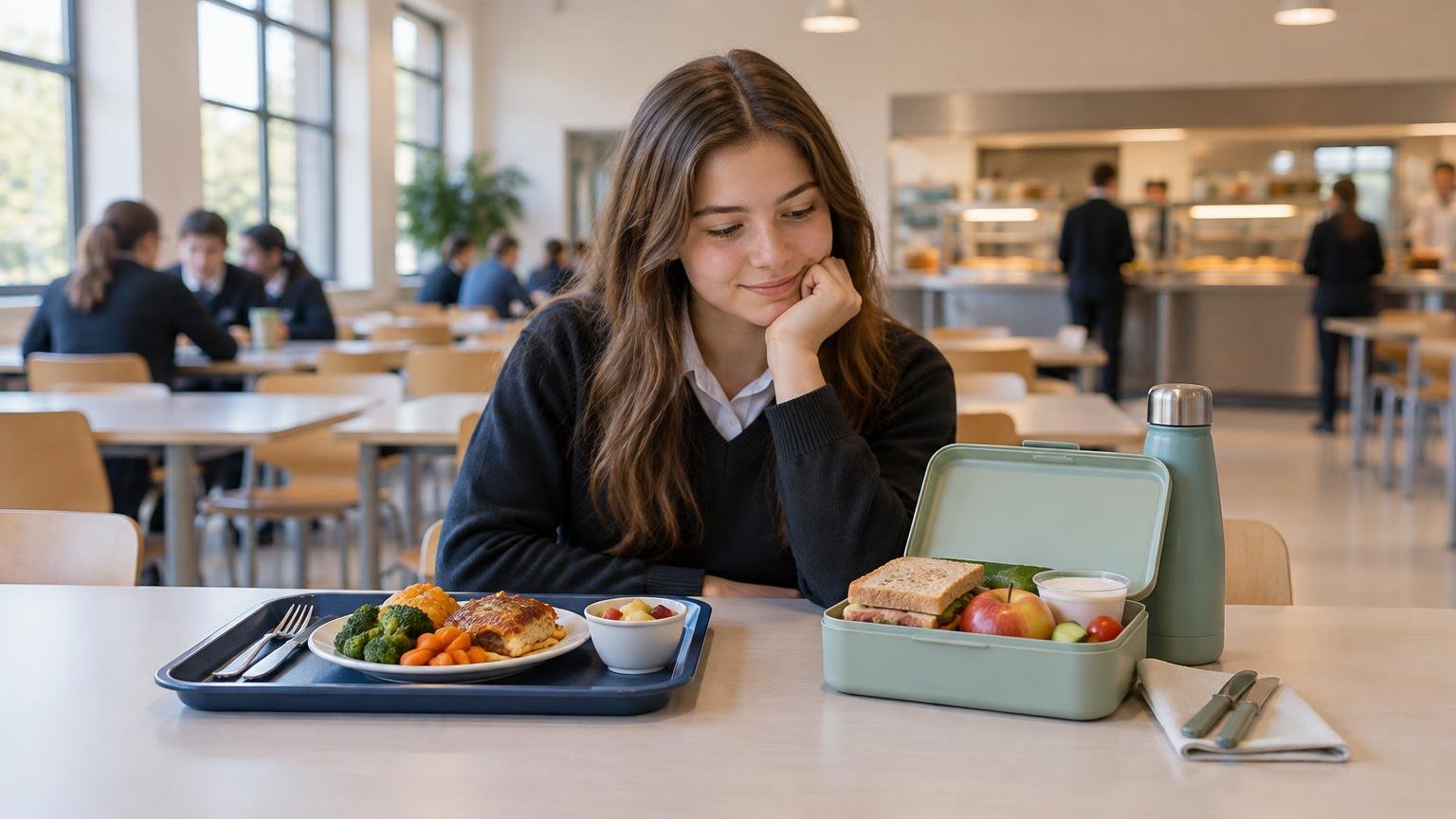
TLDR: The answer to school lunch vs packed lunch how to make either one work better is to choose the option a pupil will reliably eat and can manage during a normal school day. School meals reduce preparation and operate within a standards-based system in England. Packed lunches provide more control but require planning, safe storage and a realistic idea of what will actually be eaten. Many families will find that a mixture works best.
A lunch can look excellent on paper and still fail if the queue is too long, the portion is unappealing or half the lunchbox returns home untouched. The useful question is not which system wins in theory. It is which one leaves the pupil comfortably fed, ready for afternoon lessons and able to follow the routine without daily arguments or rushed preparation.
School lunch vs packed lunch: the practical differences
In England, food provided by maintained schools, academies and free schools is covered by school food standards. The guidance also addresses drinking water, medical and cultural needs, and suitable arrangements for pupils bringing food from home. Families can read the current school food guidance for England for the official framework. These England-specific requirements should not automatically be assumed to apply in Scotland, Wales or Northern Ireland.
That framework gives school-provided food a useful baseline, but it does not guarantee that every pupil will like every dish or have enough time to buy and eat it. Packed lunches offer more individual control, although their quality depends on what is packed, whether it stays safe to eat and whether the pupil opens the box at lunchtime rather than bringing most of it home.
| Factor | School lunch | Packed lunch | What to check |
|---|---|---|---|
| Preparation | Little or no preparation at home | Needs shopping, packing and cleaning | Who has time to manage the routine? |
| Choice | Limited to the menu and available options | Can be tailored to familiar foods | Will the pupil eat enough, not merely choose favourites? |
| Lunch break | May involve ordering or queuing | Usually ready to eat immediately | How much eating time remains after queues and socialising? |
| Cost | Depends on the school's current prices and eligibility arrangements | Depends on ingredients and how much is wasted | Compare the real weekly cost, including untouched food |
| Dietary needs | Requires communication with the school or caterer | Offers control at home but must follow school rules | What arrangements has the school confirmed? |
| Waste | Harder for parents to see directly | Uneaten food is easier to notice | What repeatedly goes unfinished, and why? |
Do not decide from the table alone. A pupil who enjoys the school menu and has a short queue may find school lunch effortless. Another who has a narrow range of accepted foods, a medical dietary requirement or limited time at lunch may do better with food from home. The answer can also change on different days.
How to make a school lunch work better
Start by looking at the current menu with the pupil rather than simply paying for meals and hoping for the best. Mark dishes they already like, dishes they are willing to try and days when none of the options seems suitable. If menus rotate over several weeks, this can quickly reveal whether school lunch is workable every day or only on selected days.
- Check the current menu, prices and portion arrangements directly with the school.
- Confirm how payment, pre-ordering or meal selection works. A missed order can turn an acceptable system into a stressful one.
- Identify two or three dependable meals in each menu cycle instead of expecting every option to appeal.
- Ask the pupil how long the queue takes and whether enough time remains to sit down and eat.
- Confirm the school's process for allergies, medical diets, cultural needs or other dietary requirements.
- Review the routine after a week: was the meal eaten, was it filling enough, and did the pupil reach afternoon lessons without feeling distracted by hunger?
If a pupil is new to secondary school, lunch can feel difficult because the location, payment system and social routine are all unfamiliar. It may help to discuss lunch alongside the other changes covered in what to expect during the first week of secondary school. A practical plan—where to go, how to pay and who to sit with—can be as important as the menu.
When a pupil says they dislike school lunch, find the specific obstacle. “I don't like it” might mean the available dish is unfamiliar, the queue consumes most of the break, friends eat elsewhere or the pupil feels rushed. Each problem has a different solution. Switching immediately to packed lunches may help, but it can also hide an issue that would be easy for the school to resolve.
How to build a packed lunch that gets eaten
A workable packed lunch does not need to be elaborate or look like a social-media food display. It needs a substantial main item, some variety and portions that suit the pupil's appetite. NHS Healthier Families suggests basing lunchboxes around foods such as bread, rice, pasta or potatoes, choosing wholegrain options where possible and involving children in planning and preparation. Its examples include wraps, bagels, pitta breads, hummus with vegetable sticks, and tuna-and-bean salad.
For more ideas, families can use the NHS collection of healthier lunchbox recipes as a starting point rather than a rigid menu.
A simple packed-lunch formula
- One substantial main item, such as a sandwich, wrap, filled pitta, pasta dish or rice-based dish.
- A protein-containing filling or side that the pupil likes and that can be stored safely.
- Fruit, vegetables or both in a form the pupil will realistically eat.
- Water or another drink permitted by the school's policy.
- An optional extra for longer days, sports sessions or a pupil with a larger appetite. Check when and where snacks may be eaten.
Preferences and dietary requirements vary, so this is a planning framework rather than a compulsory nutritional formula. A familiar lunch that is eaten is more useful than an ambitious lunch that returns untouched. Introduce one change at a time: change the bread, filling, fruit or side rather than replacing the whole meal at once.
Make preparation quick enough to repeat
The strongest routine is one that still works on a busy Wednesday morning. I would choose five or six dependable main items and rotate them. Keep suitable ingredients together, prepare what can safely be prepared the night before, and ask the pupil to take responsibility for one stage such as filling a water bottle, choosing fruit or cleaning the lunchbox.
A simple evening check can prevent most morning problems: main item ready, sides chosen, drink planned, cold-storage equipment available and lunchbox placed somewhere it will not be forgotten. Secondary pupils can gradually take over this check rather than waiting for an adult to pack everything.
Use uneaten food as information
Repeated waste usually tells you something useful. A full lunchbox may mean the pupil had too much food, disliked a texture, lacked enough time, could not open the packaging or spent the break elsewhere. Ask a neutral question such as “What got in the way today?” rather than turning the returned food into a telling-off.
- If the same item always returns, replace it or reduce the portion.
- If everything returns, ask about queues, lunchtime rules, friendships and where the pupil eats.
- If only the main item returns, try a smaller main with more manageable sides.
- If the pupil is hungry later, increase the substantial part of the meal rather than adding several foods they do not want.
- If packaging is difficult, use containers the pupil can open quickly and independently.
Change one variable for several days before judging it. Otherwise, it becomes difficult to tell whether the issue was the food, portion, container or lunch-break routine.
Treat allergies and food safety as non-negotiable
Families should follow the school's stated process for allergies and medical dietary requirements rather than relying on assumptions or informal messages. Department for Education allergy-safety guidance is relevant to school policies and individual arrangements in England. Confirm responsibilities, emergency arrangements and permitted foods directly with the school.
There is no universal rule that makes a particular food acceptable in every packed lunch. Schools may have local restrictions intended to protect pupils, and arrangements can change. Check the current policy before sending foods that might be restricted.
Perishable packed food needs suitable temperature control. Food Standards Agency guidance advises keeping it cool with ice or frozen gel packs where appropriate. Follow storage instructions, use a clean lunchbox or insulated bag, and discard food if its safety is in doubt.
Run a one-week lunch test
If both options are available, avoid making an all-or-nothing decision immediately. Try two school-meal days and three packed-lunch days during an ordinary week. Choose school meals the pupil expects to eat and use familiar, manageable packed lunches on the other days.
At the end of each day, give each lunch a simple rating from one to five for taste, fullness, convenience, cost, time or queues, and waste. Record one short comment as well. “Good meal but queue too long” is more useful than a single overall score.
At the end of the week, keep the strongest parts of both systems. That might mean school lunch on curry and roast days, packed lunch when clubs shorten the break, or school meals most days with one preferred packed lunch each week. Recheck the plan when the menu, timetable, appetite or activity level changes.
The best choice is the routine that survives a normal week
Neither option deserves to win simply because it is school-provided or home-packed. Choose school lunch when the menu is acceptable, the system is convenient and the pupil has time to eat. Choose packed lunch when greater control, speed or familiarity makes a meaningful difference—and when the preparation and safe-storage routine is sustainable.
The next step is simple: compare both options for one ordinary week, note what was eaten and identify the biggest source of friction. Improve that one thing first. A reliable lunch the pupil can manage independently is a better outcome than a supposedly perfect lunch that does not work in the real school day.